
Every culture has its myths. Bigfoot. The Loch Ness Monster. Area 51.
We tell these stories because they give shape to things we can’t quite explain.
Money has its own legends, too. And in my office, they show up more often than you’d expect.
The one I hear most sounds something like this:
“The account is down. The sky is falling.”
If you’ve ever looked at your retirement portfolio and thought that, you’ve encountered the myth that volatility is bad.
So this week, I want to dive deeper into that myth and 4 others that I’ve heard more and more frequently.
Myth #1: Volatility Is Bad
When most people hear “volatility,” they picture a chart falling off a cliff. We’ve seen that picture plenty in recent years — March of 2020, nearly all of 2022, and April of 2025 when tariffs rattled markets.
But in reality, volatility is misunderstood:
Volatility simply means prices move. Down — and up.
No one has ever called me upset because their account gained 8% in a quarter. We only label it “risk” when it moves against us. Yet the same feature that allows sharp declines is what allows sharp recoveries. You don’t get one without the other.
“Don’t sacrifice the temporary downs for the permanent ups.” – Nick Murray
For most families, the real risk isn’t a bear market. It’s outliving your money. Bear markets are temporary. Running out at 85 is not.
Now, to be fair, volatility does have one legitimate critic: sequence of returns risk.
If the market drops 15% in your first year of retirement and you’re taking withdrawals at the same time, your account falls further than the market — and has further to climb back. Compound that over several years, and the odds of running short increase.
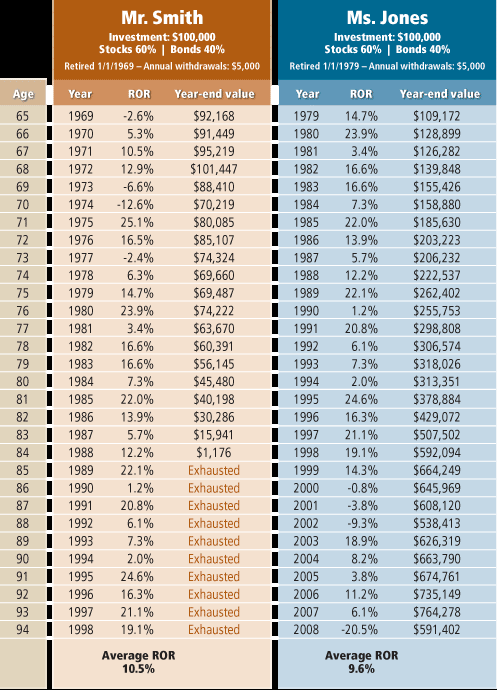
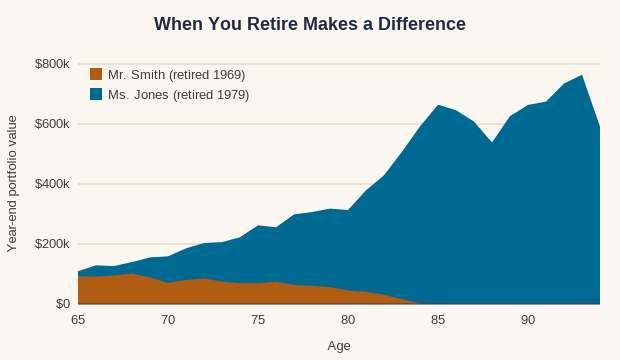
That’s worth planning around. It’s not a reason to leave the game entirely. Moving to cash may feel safe, but it often trades a risk you can feel for one you can’t: missing the recovery.
Myth #2: Permanent Life Insurance Is Always Bad
This one has a reputation — and it partly earned it.
Whole life is expensive relative to term insurance, and it bundles protection with a savings component. Anytime insurance and investing get blended, the true cost can be hard to see. It has also been oversold by people paid on commission.
If your instinct is skepticism, keep it.
But “often oversold” isn’t the same as “never useful.” For the right situation, a permanent policy can do a few things term simply can’t:
- Coverage that doesn’t expire. Term eventually ends — and replacing it at 70 or 80 can be costly or impossible.
- Accessible cash value. Over time, a policy may build value you can borrow against. (A caution: the popular “be your own bank” pitch often leans on growth promises that aren’t always guaranteed.)
- Business planning. Funding a buy-sell agreement is one of the clearest use cases. If a partner passes away, the surviving owner may need significant cash quickly to buy out the family’s share. Term is often cheaper, but a level cost of insurance plus access to cash value can make permanent coverage a strong fit for some owners.
The honest version of this myth: whole life is often sold to people who don’t need it. For the right person, in the right situation, it can be a meaningful tool.
Myth #3: Your Home Is a Great Investment
The headline numbers look compelling. The Case-Shiller National Home Price Index is up more than 80% over the past decade.1
Slam dunk, right? Not so fast. Two problems hide inside that number.
First, that gain belongs to people who already owned. If you’re buying today, that 80% isn’t your return — it’s your entry price.
Second, it’s nominal. Strip out inflation and the picture gets humbling. Robert Shiller — the economist who built that index — found real home prices rose only about 0.6% per year over the last century.2 And that’s before property taxes, insurance, and upkeep.
Then there are the costs rarely mentioned:
- A geographic anchor — less freedom to chase a better job or move closer to family.
- Interest-rate risk — if rates fall, refinancing comes with closing costs.
- Sunk costs — the roof, the water heater, the lawn, the surprise repair.
None of this means don’t buy. Stability matters, especially with young kids at home. Just be clear on what you’re buying.
A home is a lifestyle decision. Don’t confuse it with an investment strategy.
Myth #4: The Best Time to Save Is When You’re Young
Stay with me on this one — I’m going to disagree before I agree.
The conventional advice: start early, save roughly 15% from your first paycheck, and stay consistent. I think that advice is right in practice — just not for the reason most people assume.
Looked at purely as a math problem (economists call it the life-cycle model), your peak saving years are your 40s and 50s, when income is highest. In your 20s, you typically earn the least, carry the most debt relative to income, and have the fewest professional skills. On paper, the best investment a 25-year-old can make is often in themselves — skills and experiences that raise earning power for decades.
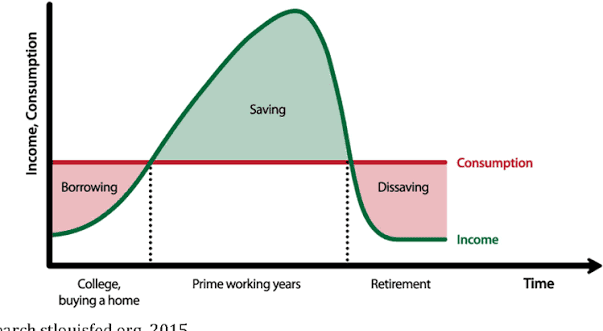
Source: Federal Reserve Bank of St. Louis, research.stlouisfed.org, 2015.
That’s the theory. Here’s why I still tell almost everyone to start young:
People don’t run on spreadsheets.
The “I’ll save more later” plan rarely happens. Lifestyle quietly expands to fill the gap. A small habit built early beats an optimal plan that requires a discipline most of us never develop.
The advice is right. Just know why it’s right.
Myth #5: The Last Generation Had It Easier
This one is less about math and more about how we feel.
On the surface, older generations had real advantages:
- One of the strongest bull markets in history
- Homes at a fraction of today’s prices
- Families supported on a single income
If you’re early in your career staring at today’s housing costs, it’s easy to feel shortchanged.
But jealousy has no exit. It doesn’t produce a plan — only more resentment.
So consider what someone entering the workforce in the late ’70s and early ’80s actually walked into:
- Two painful recessions that made finding work genuinely hard
- Stagflation — high inflation and stagnant growth at the same time
- 30-year mortgage rates as high as roughly 18.5% in 19813
- A job market shifting from stable manufacturing toward lower-paying service work
Does any of that sound familiar? A hard job market. Inflation. Expensive housing. Forces far bigger than any one person.
I’ve played the comparison game myself. It only ever led me to hopelessness — and hopelessness doesn’t build anything. When I lay the two eras side by side, the biggest difference isn’t luck.
It’s time.
Sources