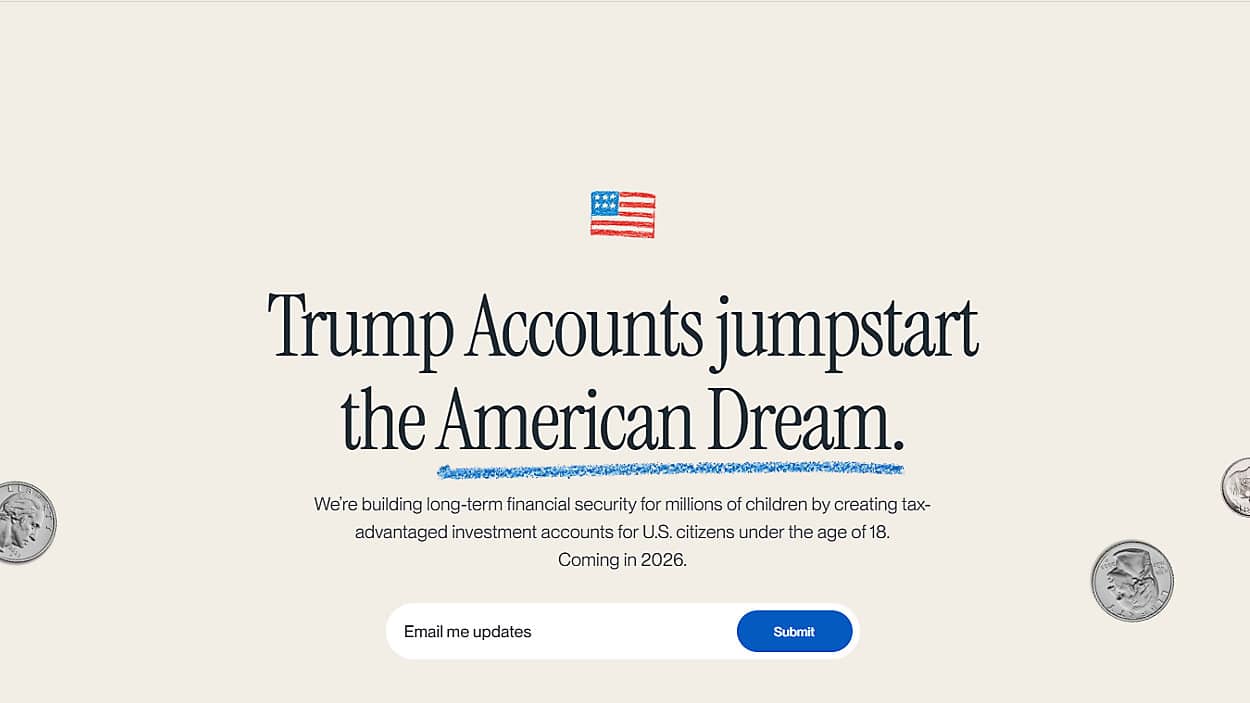
Starting next week, Trump Accounts go live and become available for any child under age 18.
Now, regardless of where you land politically — this is a financial tool with real dollar implications for the kids in your life. So understanding how it works, and where it might fit, matters — even if you never end up using it.
What Is a Trump Account?
A Trump Account is a tax-deferred savings account, similar in spirit to a Traditional IRA. A parent, grandparent, or even an employer can contribute on behalf of a child who meets the bill’s requirements.1
The money grows tax-deferred — meaning no taxes are owed on the growth until withdrawal. Once the child turns 18, the account converts into a Traditional IRA.
But here’s where it differs from a regular IRA: a Trump Account doesn’t require the child to have earned income. There’s no need to wait until they’re old enough to work. That simply means more time for tax-deferred growth to compound.
How Do I Contribute to One?
And while we’re on the topic — how does money actually get into one of these accounts? There are a few different paths, and each comes with its own rules.
1. The Federal Kickstart
If your child was born between January 1, 2025 and December 31, 2028, the federal government is offering a one-time $1,000 tax credit deposited directly into the child’s Trump Account. You have to open the account and elect to receive it — it isn’t automatic. But for qualifying newborns, that $1,000 is sitting there, waiting to be claimed.
Let that $1,000 grow in a U.S. stock index fund at historical average returns for 18 years, and you’re looking at somewhere in the neighborhood of $3,500 to $4,000 before the child even makes their first contribution as an adult.
Not a fortune — but not nothing, either.
2. Individual Contributions
Parents, grandparents, anyone, can contribute up to a combined $5,000 per year into the account. That’s the annual cap during the child’s growth period — simply the years before they turn 18.
Important to know: those contributions are not tax-deductible. You’re putting in after-tax dollars. They grow tax-deferred, and they’re taxed again on the way out.
So the tax benefit here isn’t in the contribution. It’s in the deferral.
3. Employer Contributions
This one is worth a second look if you’re a business owner. You can contribute up to $2,500 per year into a Trump Account for an employee’s child — and that contribution is tax-deductible to the business and excluded from the employee’s taxable income. If you’re thinking through employee retention tools, that’s a real benefit worth understanding.
Where Does the Money Go?
Here’s something that tripped me up the first time I read through this legislation — there are rules about where the money inside a Trump Account has to be invested during the growth period.
You cannot pick individual stocks. You cannot hold bonds. You cannot go into international funds.
The money must sit in a diversified U.S. stock index fund — think an S&P 500 fund — with annual fees no higher than 0.1%, or one-tenth of one percent.
That last piece is actually a feature in disguise. Low-cost index funds remain one of the most consistently proven vehicles for long-term wealth building. But if you’re the type who likes to be hands-on with your investments, know going in: during the growth period, you don’t have that flexibility. The account has training wheels — by design.
I’ve also put together a YouTube video on this very topic:
My Honest Take
After spending time in the research: this isn’t the most powerful savings vehicle Congress has ever created. But it’s a real one — and for the right family, it’s worth understanding.
Stay the course.
Sources