As tax season is right around the corner, you may be walking out of your accountant’s office with a tax bill you’re not too happy about.
Congratulations! It means you’ve had a good year. But how do we mitigate tax exposure while thoughtfully stewarding our assets and wealth?
Your income and net-worth alone don't determine long-term success.
In fact, they can create a false sense of security.
How your wealth is structured often matters just as much - sometimes more.
And what I see repeatedly is this:
Two people can have nearly identical financial pictures - and two completely different outcomes.
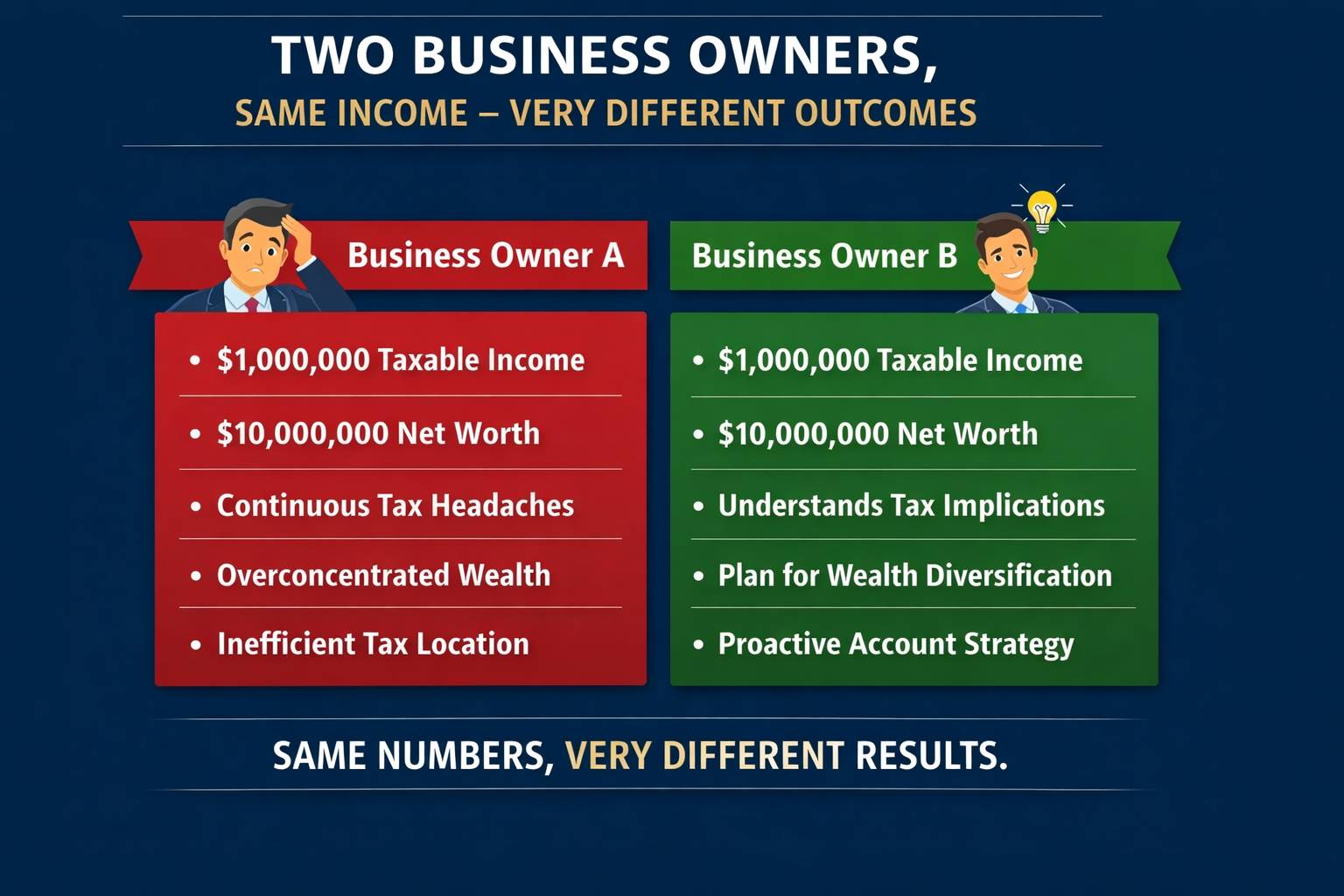
Why This Gets Ignored
Most clients I advise aren’t careless — they’re busy.
The demands of running a company push wealth planning conversations to the back burner. Taxes start to feel like “just the cost of doing business,” and the perceived hassle of restructuring feels too high.
But here’s the problem with that thinking:
That generalization could be costing you thousands of dollars every year.
When your wealth is structured intentionally — for tax efficiency, concentration management, and long-term planning — and not just writing checks to the IRS.
You’re building toward the life you actually want.
A Real-World Example
Let’s take a look at a hypothetical client, let’s call him Terry.
Terry’s snapshot:
- Age 38
- S-Corp owner paying himself W-2 wages
- Business valued at $7 million
- $100,000 in a SIMPLE IRA
- $700,000 sitting in cash
- Quadraplex worth ~$500,000
- Primary residence
At first glance, fairly straightforward.
But the first place I always look is the tax return — because your 1040 is essentially an autopsy of last year’s financial decisions.
And what showed up immediately?
$31,000 of taxable interest income.
Why?
Terry liked the peace of mind of holding large cash reserves in the bank — even though he didn’t need the money.
The result: a recurring, unnecessary tax drag.
Here’s an equation for you:
Your Tax Bracket (Fed. + State) X Interest Income = Taxes Due on Interest
The Overlooked Lever: Tax Location
Tax management often isn’t about exotic strategies.
It’s about two simple but powerful ideas:
- Tax location — where your dollars live
- Tax allocation — what those dollars are doing
In Terry’s case:
- Money located in a taxable account
- Allocated to interest-bearing instruments
- Resulting in predictable tax inefficiency
Now, to be clear — cash absolutely has a role. Emergency reserves and working capital matter.
But excessive “peace of mind” cash often creates more tax friction than most owners realize.
The Concentration Problem
Next, we reviewed Terry’s balance sheet.
Like many successful founders, the vast majority of his net worth lived inside his business.
That’s common — but it’s also risky.
Here’s the mental reframe I want business owners to grasp:
Your business is a position inside your investment portfolio.
If Terry’s $7 million business were a public stock, it would resemble a micro-cap equity — high growth potential, but also high risk.
Ignoring that concentration can quietly increase overall portfolio volatility.
Giving Each Dollar a Job
Instead of applying a blanket 60/40 portfolio across every account (a surprisingly common mistake), we assigned purpose and timeline to each dollar.
The Three Bucket Approach (+1 Extra):
Taxable Bucket — Liquidity + Tax Efficiency
So here’s what we did.
We positioned:
- Short-term cash in more tax-efficient vehicles
- Long-term dollars toward low-turnover equity exposure
- Reduced exposure to the sector already represented by his business
Goal: flexibility without excess taxes
Pre-Tax Bucket — Stability Engine
We moved Terry from a SIMPLE IRA structure into a 401(k) framework.
This accomplished two things:
- Increased contribution and profit-sharing capacity
- Eliminated the pro-rata rule obstacle, reopening the door for backdoor Roth contributions
Inside the pre-tax account, we placed:
- Bonds
- Lower-volatility dividend strategies
These investments are typically tax-inefficient in taxable accounts but work well under the tax umbrella of a qualified plan.
Goal: portfolio ballast and tax sheltering
Roth Bucket — Long-Term Growth Power
Once eligible, we directed growth-oriented investments into Roth space.
Why Roth matters so much:
- Tax-free growth
- Tax-free withdrawals in retirement
- No impact on Medicare or Social Security taxation
- Potential tax-free legacy to heirs
Because of that long runway, we avoided placing conservative assets here.
Goal: maximize compounding where taxes are permanently eliminated
Charitable Bucket — The Often-Missed Fourth Location
We also discussed donor-advised funds (DAFs).
For the right household, DAFs can:
- Create a current-year tax deduction
- Allow assets to grow tax-free
- Provide flexibility on when and where to give
This bucket often aligns especially well with stewardship-minded business owners.
Goal: combine generosity with tax efficiency
The Outcome
After restructuring, Terry now has:
- Clear understanding of how location affects taxes
- A plan addressing business concentration risk
- Defined roles for each account type
Taxable: liquidity + efficient growth
Pre-tax: stability and tax shelter
Roth: long-term compounding engine
Charitable: intentional generosity strategy
Same net worth.
Far better trajectory.
A Thought to Leave You With
If your business has created significant wealth for your family, the next phase isn’t just about growing assets.
It’s about structuring them wisely.
You may already have the numbers.
The question is whether your current structure is helping — or quietly working against you.
The mental barrier, “this is too hard and I don’t have the time”, may be costing you thousands of dollars in taxes –
when quantified that way, is it worth it?
I hope you found this valuable,
Stay the course.